
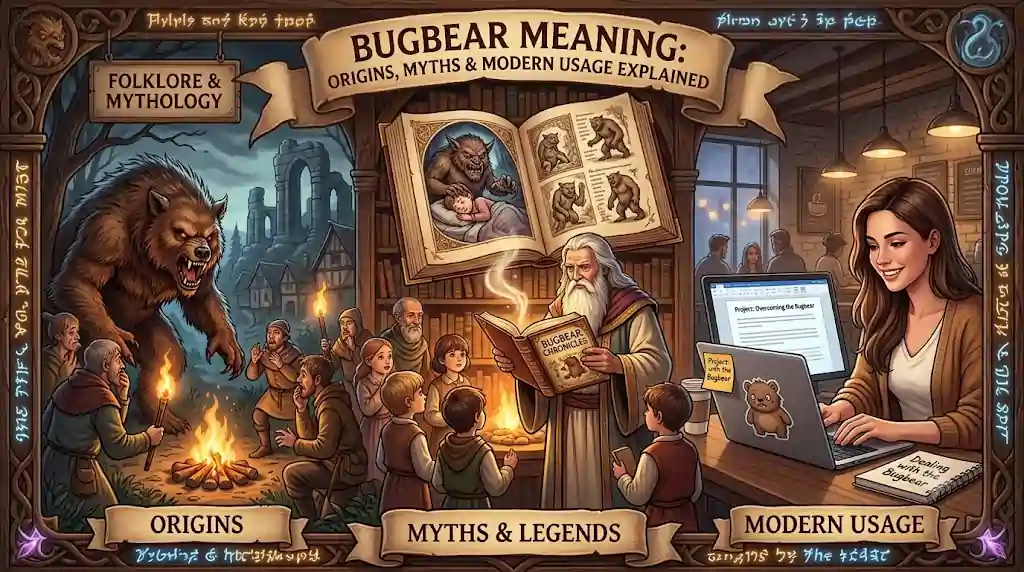
My grandmother used the word bugbear when I refused to clean my room. She pointed under the bed and warned me about the creature hiding there, waiting for messy children. I was six years old. That word stuck with me for decades. Most people hear bugbear and picture something vague and creepy. The actual bugbear meaning runs much deeper, stretching across centuries of folklore, literature, and psychology. This article unpacks everything you need to know.
What Does Bugbear Mean? A Clear Starting Definition
The term bugbear refers to an imaginary creature used to frighten children into good behavior. Parents and caretakers invoked this being as a disciplinary tool. Beyond the literal monster, the bugbear meaning expanded over time to describe any persistent annoyance, fear, or source of dread that haunts a person.
Modern dictionaries define bugbear as something that causes excessive worry or irritation. A person might call public speaking their personal bugbear. A teacher might name late assignments as a professional bugbear. The word shifted from a nursery threat to a psychological concept that captures what bothers people most deeply.
The Oxford English Dictionary traces the earliest written usage to the 1580s. Merriam-Webster records its first known appearance in 1581. This places bugbear firmly in the Early Modern English period, a time when supernatural beliefs heavily influenced daily language.
Breaking Down the Word: Bug Plus Bear Equals Terror
Linguists trace the compound structure back to Middle English roots. The “bug” portion connects to the Welsh word “bwg” and the Scottish “bogle,” both meaning ghost or hobgoblin. The “bear” part literally references the animal, an apex predator that terrified medieval Europeans.
The combination created a hybrid monster concept. Take the shapeless, haunting nature of a ghost. Add the physical danger of a wild bear. The result is something that terrifies on two levels simultaneously. This dual-threat concept explains why the bugbear meaning resonated so strongly with medieval audiences.
| Word Component | Origin | Meaning |
| Bug | Middle English “bugge,” Welsh “bwg” | Ghost, specter, frightening spirit |
| Bear | Old English “bera” | Large carnivorous mammal, symbol of physical danger |
| Bugbear (Combined) | 16th century English | A terrifying imaginary creature combining supernatural and physical threats |
The Oxford Etymologist, Dr. Philip Durkin, notes in his research that compounds like bugbear were common during periods when folklore remained deeply embedded in household language. Words carried power. Naming a fear made it controllable.
The Bugbear in English Folklore: Nursemaids and Nighttime Threats
English folklore positioned the bugbear as a shadowy creature lurking in dark corners, under beds, and inside closets. Nursemaids and mothers described bugbears as hairy, misshapen things with glowing eyes and sharp claws. The creature supposedly dragged away disobedient children who refused to sleep or finish their chores.
Regional variations across England gave the bugbear different names and appearances. Yorkshire families warned about the “boggart” in the pantry. Lancashire parents mentioned the “bugaboo” hiding near the hearth. Each version served identical purposes: behavioral control through fear.
The literary scholar Katharine Briggs documented dozens of bugbear-like entities in her Dictionary of British Folk-Tales. She categorized them under nursery bogies, supernatural beings designed specifically to frighten the youngest household members into compliance.
Actual historical texts from the Tudor period reference bugbears in domestic contexts. Household manuals from the 1500s advised parents to use mild fear of imaginary creatures rather than physical punishment. The bugbear meaning at this point was entirely practical. It was a parenting tool wrapped in supernatural packaging.
Bugbear Versus Bogeyman: Understanding the Difference
People frequently confuse bugbears with bogeymen. The two share obvious DNA. Both are imaginary creatures. Both target children. Both thrive in darkness and hidden spaces.
The distinction lies in scope and cultural weight. The bogeyman evolved into a universal archetype appearing in cultures worldwide. Almost every society has a version of the bogeyman who punishes children. The bugbear remained more specifically British, more tied to household folklore than grand mythology.
The table below clarifies the key differences:
| Feature | Bugbear | Bogeyman |
| Cultural Origin | Specifically British Isles | Global, with variations in most cultures |
| Primary Purpose | Household discipline, behavioral correction | Broader fear symbol, stranger danger |
| Physical Description | Hairy, bear-like, shadowy | Varies widely, often shapeless or adapting to cultural fears |
| Modern Usage | Annoyance or persistent worry | Still used for threatening strangers or abstract danger |
| Literary Presence | Shakespeare, 16th-17th century texts | Modern horror, film, widespread media |
The bogeyman became famous. The bugbear stayed local. That localization preserved the original bugbear meaning without the Hollywood treatment that transformed the bogeyman into a cinematic villain.
Shakespeare and the Literary Bugbear: Classical References
William Shakespeare loved the word bugbear. He deployed it strategically across multiple plays. In The Taming of the Shrew, characters reference bugbears when mocking irrational fears. In Romeo and Juliet, Mercutio uses language that evokes bugbear imagery during his Queen Mab speech.
Edmund Spenser included bugbears in The Faerie Queene. Thomas Nashe wrote about bugbears in his pamphlets during the 1590s. These literary giants recognized something powerful in the concept. The bugbear represented the irrational fear that grips people despite lacking any real threat.
Shakespeare scholar Harold Bloom argued that Renaissance writers used bugbear references to explore human psychology before psychology existed as a formal discipline. The creature symbolized how minds create monsters worse than any real danger.
Modern Bugbear Meaning: From Monster to Metaphor
Contemporary English uses bugbear almost exclusively as a metaphor. Nobody checks under the bed for literal bugbears anymore. The word survived by adapting.
A modern bugbear is a personal annoyance that feels larger than it should. Traffic jams. Slow internet connections. People who chew loudly during meetings. These small irritations become mental bugbears that haunt daily life disproportionate to their actual importance.
The British publication The Economist uses bugbear regularly in political commentary. Journalists describe policy proposals as “a particular bugbear for Conservative backbenchers” or “an ongoing bugbear for the Treasury.” This modern application keeps the word alive while stripping away the supernatural elements entirely.
Linguist Gretchen McCulloch, author of Because Internet, notes that words like bugbear survive because they fill an emotional niche. English lacks a perfect synonym. Annoyance feels too mild. Obsession feels too strong. Bugbear sits exactly between them, capturing that specific space where irritation meets anxiety.
The Psychology Behind Bugbears: Why We Create Imaginary Monsters
Psychologists recognize the bugbear phenomenon as a manifestation of projection. Humans take internal fears and project them onto external objects or creatures. A child afraid of abandonment creates a monster under the bed. An adult afraid of failure develops an irrational hatred of email notifications.
Dr. Stephen Asma, professor of philosophy and author of On Monsters, explains that imaginary monsters serve evolutionary purposes. They help humans process fear in manageable doses. The bugbear meaning extends beyond folklore into cognitive science. These creatures function as training tools for real-world dangers.
The mechanism works like this:
- The brain identifies a diffuse anxiety
- The mind gives that anxiety a name or form
- The named fear becomes easier to confront
- Confronting it reduces the original anxiety
Bugbears, both literal and metaphorical, help people organize emotional chaos. Naming your bugbear is the first step toward managing it.
Bugbear in Gaming Culture: Dungeons and Dragons Legacy
Gamers worldwide recognize bugbears as a specific creature type. Dungeons and Dragons introduced bugbears as larger, hairier cousins of goblins in the original 1974 rulebook. These monsters stand about seven feet tall, covered in thick fur, with flat noses and sharp teeth.
Dungeons and Dragons lore positions bugbears as stealthy ambush predators. They move quietly despite their size. They attack without warning. Game designers borrowed the name and some physical characteristics from folklore but created a combat-focused interpretation that drives tabletop adventures.
| Bugbear Gaming Trait | Description |
| Size | Large, typically 7 feet tall |
| Fur Color | Yellowish to dark brown |
| Stealth Ability | Surprising quiet movement for size |
| Combat Style | Ambush tactics, surprise attacks |
| Intelligence | Low to average |
| Alignment | Typically chaotic evil |
Wizards of the Coast, publisher of Dungeons and Dragons, keeps bugbears as core monster manual entries. The creature appears in video games like Baldur’s Gate 3, World of Warcraft, and countless fantasy titles. The gaming bugbear meaning now reaches audiences who never heard the original folklore version.
The Political Bugbear: How the Word Shapes Public Discourse
Politicians and journalists weaponize the bugbear concept deliberately. Calling something a bugbear frames it as an irrational fear rather than a legitimate concern. This rhetorical move dismisses opposing viewpoints without directly engaging them.
Consider how newspapers apply the term. Immigration becomes “a longstanding bugbear for the party’s right wing.” Climate regulations turn into “the industrial sector’s primary bugbear.” Each usage suggests the concern is overblown, emotional, and disconnected from reality.
Media scholar Noam Chomsky analyzed this technique in Manufacturing Consent. Labeling opposition as fear-based rather than reason-based delegitimizes dissent. The bugbear meaning in political contexts carries this dismissive power subtly but effectively.
Regional Variations: Bugbears Around the British Isles
The bugbear concept splintered into distinct regional forms across the United Kingdom. Each area developed its own version with unique names and characteristics.
- Scottish Highlands: The “bogle” haunted lonely roads and moorlands, appearing as a shapeless shadow
- Yorkshire: The “boggart” inhabited specific houses, causing mischief rather than direct harm
- Welsh Valleys: The “bwbach” guarded homes and expected offerings of milk and bread
- Cornwall: The “bucca” lived in mines and coastal caves, sometimes helpful, sometimes threatening
- East Anglia: “Old Shuck” took the form of a giant black dog with glowing eyes
Folklorist Jacqueline Simpson documented these variations extensively in The Lore of the Land. She notes that the core bugbear meaning remained consistent despite regional differences. Each version punished bad behavior, rewarded good conduct, and gave children a reason to stay in bed after dark.
Summary of Key Bugbear Concepts
| Aspect | Detail |
| Origin Period | 1580s, Tudor England |
| Original Meaning | Imaginary creature frightening children |
| Modern Meaning | Persistent annoyance or irrational fear |
| Related Terms | Bogeyman, boggart, bogey, bugaboo |
| Literary Usage | Shakespeare, Spenser, Nashe |
| Gaming Usage | Dungeons and Dragons, World of Warcraft |
| Psychological Function | Projection of internal anxiety onto external forms |
How to Use Bugbear Correctly in Modern Writing
Understanding the bugbear meaning allows precise, effective usage. Here are practical examples showing correct application across different contexts:
In formal writing:
“Budget constraints remain the department’s primary bugbear this fiscal year.”
In casual conversation:
“Spelling errors are my biggest bugbear. I catch them everywhere.”
In journalism:
“Housing policy continues as a political bugbear for the administration.”
In creative writing:
“Childhood bugbears resurfaced whenever she entered empty rooms at night.”
Avoid using bugbear when simpler words work better. Do not describe actual bears as bugbears. Do not confuse bugbears with nightmares, which happen during sleep. The word refers to waking anxieties given imaginary forms.
Frequently Asked Questions
What is the original bugbear meaning?
The original bugbear meaning refers to an imaginary creature from British folklore that adults used to frighten children into obedience. The word combines “bug” meaning ghost and “bear” meaning the animal.
Where did the word bugbear originate?
The word originated in 16th century England as a compound of Middle English “bugge” and “bera.” Folklorists trace similar words to Welsh and Scottish roots related to spirits and hobgoblins.
How is bugbear different from bogeyman?
Bugbear stayed primarily within British folklore and now means a persistent annoyance. Bogeyman spread globally and still refers to a frightening imaginary figure who threatens children.
What does bugbear mean in modern language?
Modern usage describes any persistent source of irritation, worry, or annoyance. People call traffic, deadlines, or specific habits their personal bugbear.
Why does Dungeons and Dragons use the name bugbear?
Dungeons and Dragons borrowed the name from folklore for a large goblin-like monster. The game version emphasizes stealth and ambush tactics while keeping the frightening appearance from traditional bugbear stories.
How do you use bugbear in a sentence?
Example sentences include: “Loud chewing is my biggest bugbear” or “The new regulation became a bugbear for small business owners.” Use it to name a specific, persistent annoyance.