
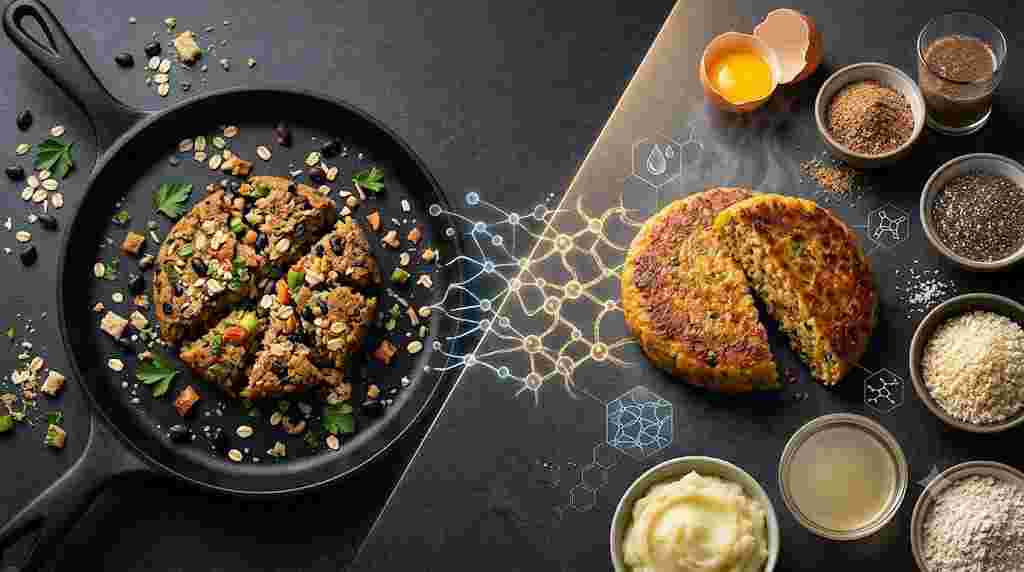
You’ve meticulously followed the food recipe, yet the moment your spatula touches the veggie burger, it disintegrates into a sad, crumbly heap. The frustration is visceral—watching hours of prep turn to dust because the structure failed. This isn’t a failure of your culinary talent; it’s a failure of chemistry. You’re missing the critical “glue.” The fix is instant once you master the answer to what is a binder in cooking and stop guessing.
KEY TAKEAWAYS: The Binder Cheat Sheet
- Molecular Bridge: Binders work by denaturing proteins that unwind and trap water, then coagulate into a rigid gel network upon heating, physically locking other ingredients in place.
- Dry vs. Wet Ratio Failures: A soggy patty doesn’t need more flour; it needs a hygroscopic binder like breadcrumbs that absorbs free-floating moisture before the cooking phase begins.
- The Resting Imperative: Letting a mixture sit for 15 minutes allows soluble fibers in plant-based binders to fully hydrate. Skipping this step leaves gritty, loose pockets in your final texture.
The Structural Chemistry of Binding Agents
A binder isn’t just an ingredient; it’s a three-phase structural event. First, hydration causes swelling. Second, mechanical mixing unravels proteins or creates a sticky matrix. Third, thermal application solidifies the scaffold. If your cooking lacks this sequence, you’re simply heating loose particles, not building a unified whole.
Denaturation and Coagulation: The Heat Trigger
Think of raw egg white as a tightly coiled ball of amino acid chains. Heat violently shakes these coils loose (denaturation), causing them to unravel. These now-linear strands bump into one another and weld together (coagulation), transforming from a viscous liquid to a solid, supportive scaffold. This is why a casserole without egg collapses upon slicing.
The Viscosity Trap: Why Binders Feel “Slimy”
Effective binders exhibit non-Newtonian fluid behavior. Cornstarch slurry, for example, resists sudden movement, allowing you to apply force without splashing. When heated, the starch granules swell until they burst, releasing amylose molecules that tangle into a semi-rigid gel. This “slime” to “solid” transition is the hallmark of a successful hold.
Protein-Based Binders: The Animal Kingdom Glue
Animal proteins offer the most aggressive binding because they contain myosin, a sticky muscle protein that forms dense, heat-stable gels. This is the ultimate insurance against a recipe falling apart.
Egg Phases: Yolk vs. White
Eggs aren’t a monolith. Yolks are high in fat and emulsifiers; they bind via emulsions, perfect for sauces. Whites are pure protein and water; they bind via rigid foam scaffolding, ideal for structural integrity in baked croquettes. Using a whole egg gives you a hybrid: the fat adds tenderness, while the white maintains rigidity.
Gelatin’s Reversible Hurdle
Gelatin forms a triple-helix junction zone, trapping liquid in a delicate, thermo-reversible mesh. It’s brilliant for cold terrines. However, it’s a thermal liability—a hot buffet line will melt your carefully constructed pâté into a weeping pool. Use it strictly for dishes served chilled.
Plant-Based Mechanics: Trapping Water Without Eggs
Plant binders don’t unfold proteins the way eggs do; they rely on soluble fiber and starch swelling. The strategy shifts from protein coagulation to a hygroscopic matrix that physically absorbs free water, creating a sticky paste.
| Binder Type | Mechanism of Action | Hydration Ratio (Binder:Water) | Pitfall |
| Flax “Egg” | Mucilage gum swelling | 1 tbsp meal : 2.5 tbsp water | Fails under high-heat broiling |
| Chia Seeds | Polysaccharide gel sheath | 1 part seed : 6 parts water | Gummy, dense texture if unblended |
| Mashed Legumes | Starch granule paste | Direct mix (no pre-hydration) | Gritty mouthfeel if un-sieved |
| Aquafaba | Protein/starch synergistic foam | Whip straight from can | Fragile; shatters under heavy fat loads |
Dry vs. Fresh: The Absorption Ratio Crisis
The liquid saturation point determines whether you need a dry or wet binder. A dry binder (breadcrumbs, oat flour) acts as a desiccant, pulling moisture in. A wet binder (mashed potato, pumpkin puree) adds moisture. The error zone is crossing streams without recalibrating—adding a wet binder to an already loose mix guarantees structural mush.
Breadcrumbs as a Hydrocolloid Matrix
Don’t treat breadcrumbs as filler; they are a rigid hydrocolloid matrix. Fresh bread instantly clumps and forms a dense paste. Stale or panko breadcrumbs, with their dehydrated starch structures, possess greater capillary action, pulling liquid into their porous network and swelling without turning gluey. This creates friction surfaces that lock meat granules together in meatballs.
Nut Butters and Fat Solidification
A binder doesn’t require water. Nut butters act via temperature-dependent phase change. They are semi-solid and sticky at room temp, providing adhesion. Under heat, the oils liquefy, causing a temporary loss of structure. The binding only returns upon cooling and resolidification. This is the principle behind no-bake peanut butter energy balls holding shape.
The Aquafaba Anomaly
Drained chickpea water defies the plant-based rule of “thickening only.” It forms a thixotropic foam that, despite having no egg protein, creates a crystalline network capable of entrapping air and moisture. However, it’s chemically fragile. Oils act as de-foamers, popping the delicate air bubbles. Use it strictly as a low-fat binder for lean, baked items where crispness isn’t the primary goal.
Commercial Binder Technology
Processed food relies on transglutaminase, colloquially called “meat glue.” This enzyme doesn’t just trap; it covalently bonds lysine and glutamine amino acids across meat surfaces, literally fusing separate muscle cuts into one seamless log. It operates via molecular cross-linking, a pure chemical weld unreplicable by home kitchen ingredients.
Troubleshooting: The Soggy Bottom Fallacy
If your patty is crumbly, it lacks a liquid-phase bridge. Add a beaten egg. If your patty is soggy yet crumbly, you’ve created a shear-thinning failure—the fat melted before the proteins set. The fix isn’t more binder; it’s chilling the raw mix to 34°F to ensure the fat stays solid long enough for the protein scaffold to thermally set in the pan.
Future Outlook: The Clean-Label Replacement Race
The industrial push is moving away from methylcellulose, which requires precise thermal gelation, toward fermented pea protein isolates. Unlike starch-based binders that retrograde and release water upon freezing, these fermented isolates create a freeze-thaw stable gel. For home cooks, expect a surge in recipes utilizing “aquafaba powder” to bypass the fragility of the canned liquid version, achieving egg-white strength without the volatility.
Frequently Asked Questions
What is the primary mechanical function of a binder in a recipe?
A binder’s mechanical function is to reduce the interstitial spacing between solid particles, replacing air pockets with a viscous gel that solidifies upon heating, thus preventing the matrix from fracturing under shear force.
How does a flax egg chemically replace a chicken egg?
Ground flaxseed contains a polysaccharide gum in its hull that swells by a factor of 10 when hydrated, creating a mucilaginous gel that mimics the clinging viscosity of raw albumen without the coagulation hardness.
Why do my black bean burgers still fall apart even with egg?
Legumes contain negligible amounts of gluten or strong starch; they rely on high-fiber density. If the bean puree is too wet, the egg protein is over-diluted and cannot coagulate into a firm enough cage to hold the weight of the bean solids.
Can you use instant mashed potato flakes as a binder?
Yes, potato flakes function as a pre-gelatinized rapid-hydration starch sponge. They instantly absorb free moisture and swell into a tacky paste, making them superior to raw flour for quick-cooking ground meat mixes.
What is the most heat-resistant binder for high-temperature searing?
Whey protein isolate offers superior heat-set gel strength compared to eggs or starches. It forms a firm, slightly elastic gel that resists melting even under direct flame contact, though it dries out faster if overcooked.
How do you fix a binding mix that is too wet without changing flavor?
Add unflavored pork rind panko or neutral egg white powder. These are essentially pure protein solids that absorb water weight-for-weight without introducing competing flavors, unlike breadcrumbs which can mute spice profiles.
Let’s Talk Texture
That perfectly held-together slice is a choice, not a miracle. It’s the mastery of water activity and protein coagulation. Which binder has failed you before, and are you ready to fix it with the right hydration ratio next time? Drop your structural disaster stories in the comments.