Finding the Best Pain au Chocolat Near Me: A Flaky, Buttery Master Guide
Introduction
You woke up craving that first bite of a golden shell, the one that shatters into delicate flakes before your teeth sink into rich, melted dark chocolate. A factory-made substitute won’t cut it today. You need the real thing, crafted with patience and French butter. This guide puts you steps away from the ultimate local pastry. We bypass the stale imitations to connect you directly with bakers who understand temperature, time, and lamination. Stop scrolling through generic lists and use a clear method to judge freshness, texture, and quality. Your perfect morning starts with this exact search.
Real Butter vs. Shortening: The Lamination Decider
A bakery’s ingredient list reveals everything about their product. Top-tier establishments rely exclusively on high-fat European-style butter, typically containing 82-85% butterfat. This high fat content creates distinct, separated layers during the lamination process because pure butter releases steam as it melts. Shortening stays soft and combines with the dough, eliminating the honeycomb structure you want. When hunting for pain au chocolat near me, ask the counter staff a simple question: “Do you use butter or shortening?” If they pause or mention margarine, lower your expectations immediately. The distinct tang of cultured butter leaves a clean, nutty finish on your palate, while substitutes coat your mouth with a waxy film.
Visual Signals of a Perfect Bake
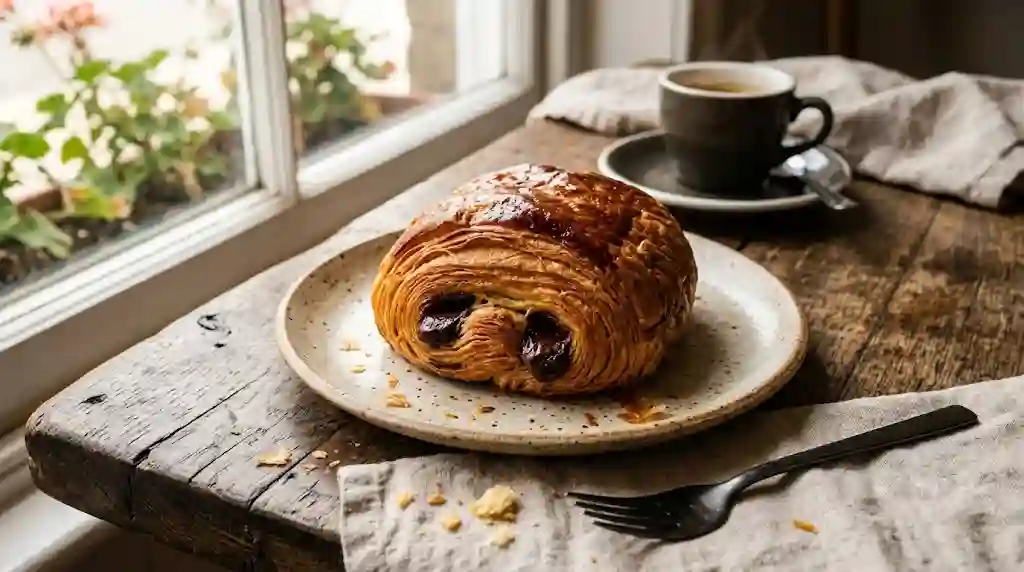
Your eyes tell you everything before you take a bite. A properly baked pastry shows a deep mahogany brown, never pale blonde. This coloring proves the sugars in the butter and dough underwent the Maillard reaction, creating deep caramel notes. Inspect the base. A soggy bottom indicates a rushed final proof or an oven temperature set too low, meaning the inner layers absorbed steam instead of staying separate. When examining a bakery display for the best pain au chocolat near me, look for distinct ridges where the dough folded over itself. Visible separation suggests the baker gave the yeast enough time to lift each layer individually.
The Sound of Freshness
Pick it up with your thumb and forefinger. A fresh specimen crackles softly if you squeeze the crust gently. This fragile exterior breaks at the lightest touch, flaking onto the parchment paper. Stale products become soft and silent, the humidity in the air having already collapsed the crust’s rigid architecture. Avoid buying a pastry encased in plastic cling wrap, as trapped steam turns shattering layers into a chewy, bread-like mass within 20 minutes. Aim for the 7 a.m. baking window; high-volume bakeries bake twice a day. or 11 a.m. pull to catch them within the optimal freshness window.
Chocolate Baton Quality: The Melt Point
Viennoiserie demands chocolate that resists fully melting during the bake. Real patisseries use tempered batons with a high cocoa butter ratio, often around 44%. This formulation holds its shape inside the hot envelope of dough, remaining slightly thick and molten even after cooling. Mass-produced brands might swap these sticks for chocolate-flavored compound coating, which turns grainy and solidifies into a chalky block. Two batons should run parallel down the center. If a bakery distributes small chips, the chocolate usually burns against the metal tray or disappears into the dough during baking. The center should exist as a distinct, dark vein.
Local vs. Imported: The Frozen Debate
Many cafes proudly advertise “imported from France,” yet this signals a frozen, long-distance journey. Flavor degrades the moment air hits the butter lipids; a four-week shipping process accelerates this oxidation, creating a faint cardboard aftertaste. A local baker who laminates by hand at four a.m. in your own neighborhood serves a product that never saw a blast freezer. Supporting these artisans gives you peak vitality. Finding a truly artisanal pain au chocolat near me means prioritizing production date over the label’s country of origin. Freshly baked goods don’t ship well, and pastry knows no passport.
Price Analysis and the Butter Index
The global dairy crisis pushed butter prices to historic highs, and pastries reflect this cost. You should expect to pay between $4.50 and $7.50 for a hand-laminated piece. If a café charges $3.00 or less, run a simple calculation: covering high-cost butter, dark chocolate batons, laborious folding, and store overhead is mathematically impossible at that price. They are cutting corners on raw ingredients. Paying a premium directly funds the local dairy farmers supplying the cream. Use price as a quality filter; you are buying edible art, not just a breakfast calorie.
Table: Visual Quality Checklist for Pain au Chocolat
| Feature | Flawless Pastry Indicator | Low-Quality Red Flag |
| Color | Uniform dark mahogany/reddish-brown | Pale yellow, uneven tan patches |
| Structure | Glass-like crisp crust, standing tall | Flat, collapsed, doughy side walls |
| Layers | Visible “honeycomb” air pockets inside | Dense bread-like crumb, no air holes |
| Chocolate | Two distinct melted dark batons | Scattered chips, grainy brown smear |
| Aroma | Nutty, toasted brown butter | Acrid, burnt sugar or oily shortening |
Top 10 Local Spots Hitting the Mark
- Dominique Ansel Bakery (NYC) – Reinvented the DKA but respects the classic two-baton structure religiously.
- Tartine Manufactory (San Francisco) – Uses a liquid levain in their enriched dough, adding a faint sour note that cuts the butter fat perfectly.
- Belle Époque (Miami) – Their laminated dough undergoes a 72-hour cold fermentation, deepening the wheatie flavor notes.
- Standard Baking Co. (Portland) – Burns the edges slightly for a bitter caramel contrast against the sweet Valrhona batons.
- Lune Croissanterie (Melbourne/Austin) – Climate-controlled lamination rooms prevent butter leakage before the oven spring kicks in.
- La Parisienne (Chicago) – Holds the title for most symmetrical honeycomb structure in the Midwest.
- Burdick’s (Boston) – Molds their own solid chocolate sticks in-house, sourcing from single-origin Peruvian beans.
- Rosetta Bakery (Miami Beach) – Ships Italian-style burro di panna specifically for the elevated fat content.
- Proof Bakery (Los Angeles) – Sources organic flour milled within 40 miles of the shop, maintaining gluten elasticity.
- Bakery Nouveau (Seattle) – Twice-baked style for those who prefer an aggressively glassy caramelized crust.
Butter Leakage: The Greasy Truth
If your pastry sits in a translucent pool of yellow grease, the baker rushed the proofing phase. Cold butter forced directly into a hot oven melts outward instead of creating interior steam pockets. A master baker rests the log between turns so gluten relaxes and butter temperature stays consistently between 16°C and 18°C. Minor leakage creates a crisply fried bottom, which tastes delicious. Excessive grease, however, means your money went into butter that now coats the paper, not the dough. Judge the paper after eating the best pain au chocolat near me; a thin, transparent stain denotes perfection.
The Gluten Window Test
Hold your pastry up to natural light or a window. Peer through the torn edge. You should see a complex web of fine, translucent gluten sheets stretching between air pockets. This structural framework requires high-protein bread flour, not soft cake flour. Bakers who rest the dough adequately allow gluten strands to align and stretch thin enough to become translucent. When you see this window, you’ve found an expert who prioritizes baking science over cutting corners. The chew should feel tensile and elastic, pulling apart like a soft taffy without snapping.
Storing and Re-Crisping Protocol
Never refrigerate these pastries unless you enjoy a soggy, stale disaster. The refrigerator accelerates starch retrogradation, forcefully ejecting moisture from the flour and gelatinizing the crust. Instead, store leftovers in a dry paper bag on the counter for eight hours maximum. To revive a slightly old piece, preheat an oven to 350°F and heat for three to four minutes. Avoid microwaves completely; they create steam and turn crisp lamination into a rubbery sponge. The direct, dry heat from an oven or toaster oven evaporates trapped humidity and rejuvenates the butter’s glassy texture.
Regional Naming and Expectations
Walk into a Latin American panadería and ask for a chocolate croissant, and they’ll hand you something different—often enriched with sugar and egg. In Texas kolache shops, the version comes enclosed in a soft yeast dough. Understanding the cultural context of your location refines your search; a “chocolatine” (used in Southwestern France and parts of Canada) often implies a higher ratio of chocolate to dough. If you type pain au chocolat near me, ensure the bakery’s menu pictures match the laminated definition. Accurate terminology helps bypass the disappointment of biting into a soft, sweet roll when expecting a thousand shattering sheets.
The Double-Bake Trend
Some bakers push the finished pastry into the oven a second time. This technique dehydrates the dough further, producing a rustically dark crust that remains crisp for hours rather than minutes. The caramelization intensifies significantly, swinging the flavor profile from a buttery morning bite toward a dark, toasty companion for espresso. The double-baked pain au chocolat near me holds its structure when dipped into hot coffee, refusing to dissolve into a soggy heap. Seek out this style if you plan to wait before eating or prefer an audible crunch that rivals a potato chip.
FAQ Section
What makes high-quality pain au chocolat near me stand out from a regular chocolate croissant?
High-quality versions use 100% pure butter and tempered dark chocolate batons, not compound chocolate. The visual structure shows a distinct honeycomb network inside a deeply caramelized shell. Low-grade imitations feel bready or soft, often using margarine to save cost. An elite bakery will produce an audible shatter when you squeeze the crust.
Where can I find authentic butter-based pain au chocolat near me open right now?
Open your maps application and use the “Open Now” filter while searching for French patisseries or artisan bakeries. Look for photographic evidence of a glossy, dark brown exterior in customer reviews. Call directly to ask if the viennoiserie program uses French-style butter with high butterfat content. Avoid places that solely list “croissant” without specifics on origin or production.
How do I verify freshness when buying pain au chocolat near me early morning?
Time your visit for when the display cases are fully stocked, typically within 30 minutes of opening. Press gently on the crust; it must feel rigid and brittle, not soft or pliable. Scan the bottom for translucent butter spots indicating a correct bake. A fresh product smells intensely nutty and toasty, lacking any stale, damp cardboard scent.
Why is the best pain au chocolat near me so expensive compared to grocery stores?
Hand-lamination takes three days, involving precise temperature control and manual folding. European-style butter costs roughly 40% more than domestic shortening, and couverture chocolate batons double the expense of compound chips. Skilled viennoiserie bakers demand high wages for their technical labor. The price reflects a craft that machines cannot replicate on a mass scale.
Can I freeze an artisanal pain au chocolat near me without ruining the layers?
Yes, wrap it tightly in aluminum foil immediately after purchasing, before it loses its crispness. Place the wrapped pastry in a freezer bag to lock out humidity and prevent ice crystal formation. Reheat directly from frozen in a 350°F oven for 6-8 minutes. Do not thaw it on the counter first, as condensation will cause sogginess upon reheating.
What is the chocolate baton ratio in a traditional pain au chocolat near me?
A rectangular dough pad should cover two parallel batons of bittersweet chocolate, never just a smear. Each baton typically weighs 3 to 4 grams, creating a 25-30% chocolate-to-dough weight distribution. Proper batons contain enough cocoa butter to maintain a semi-liquid state at room temperature. If the chocolate fully solidifies into a hard rock, the cocoa fat content was too low.
Conclusion
The distance between a generic croissant and a life-changing pain au chocolat near me sits entirely in the details. You’ve armed yourself with the ability to spot a master laminator by their honeycomb structure and to reject impostors hiding behind imported labeling. Don’t settle for a soggy, margarine-heavy substitute when butter artisans are shaping dough blocks three blocks from your apartment. Open your map right now, scan the early morning bakeries, and walk toward the shop with the darkest, glossiest pastries in the case. While it is still warm, bite into it. The search ends with you holding that golden, crisp packet of chocolate and butter. Go get it.